
No matter what the verdict against Bishimbayev turns out to be, change in relation to domestic violence in Kazakhstan is long overdue.
By Mia Tarp Nurmagambetova April 20, 2024 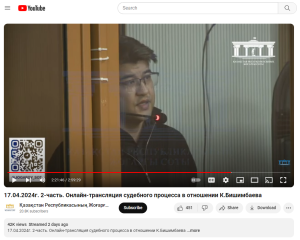
A screenshot of YouTube, where hearings in the Bishimbayev trial are streaming live.
Credit:
A high-profile trial in Kazakhstan is highlighting the entrenched problem of domestic violence in the country. The court proceedings against former Minister of Economy Kuandyk Bishimbayev are being live-streamed to the public, intensifying attention to the case and the broader issues. Bishimbayev is accused of beating his wife, Saltanat Nukenova, to death. A heated discussion about domestic violence has flared up once again while the nation holds its breath pending the verdict.
On November 9, 2023, Bishimbayev and his wife Nukenova were in an Astana restaurant, where Bishimbayev spent several hours beating her, after which she died. Much of the violence was captured by security cameras in the restaurant. Bishimbayev is currently on trial for murder. But – even if found guilty – he is far from the only perpetrator of domestic violence in the country.
Domestic violence remains a significant problem: between 15 and 49 years of age have experienced violence from a partner in their lifetime. , according to data from one of International Partnership for Human Rights’ (IPHR) partners in Kazakhstan, the . However, domestic violence is often considered a taboo subject and , due to societal stigma or forced reconciliation of victims with their abusers.
But why is domestic violence so common? One of the reasons is the patriarchal structure of society, which devalues women, favors narrow stereotypical gender roles, and gives women no decision-making powers. Being a woman is far from easy; women’s appearances and actions are widely regulated by societal norms. Tatiana Chernobil, a human rights expert said that “.”
that this devaluation and objectification of women increases the risks of them being subjected to intimate partner violence. puts tremendous pressure on women, particularly newlywed brides, so-called “kelins.” Traditionally, a bride moves in with her husband and in-laws, where she is responsible for household chores, expected to be obedient and submissive, and expected to give birth to children. A man, on the contrary, , regardless of a woman’s achievements and education.
Domestic violence is often also excused by guardians of morality on state TV. Recently, the hosts of a spoke to a woman who had fled her husband and moved to a crisis center after enduring almost two decades of alcohol-fueled violence from her husband. The hosts shockingly brought in her ex-husband, and attempted to coerce her to reconcile with him – fortunately without success. The hosts even engaged in victim-blaming by suggesting that the woman had provoked her husband by not performing household duties properly, making her husband jealous and, it was insinuated, perhaps driving him to alcoholism. Fortunately, the show was taken off the air.
Ex-minister Bishimbayev used a similar tactic to into thinking that his wife was actually to blame for the spate of violence that resulted in her death last November. He Nukenova of aggression, being psychologically unstable, drunk (although an ), and prone to , implicitly justifying his actions. Bishimbayev admits causing her death, but claims it was not done intentionally.
The whole of Kazakhstan is talking about this trial, both on and offline. People are angry, and the Domestic violence and femicide is back on the agenda again.
In a welcome move, on April 15 criminalizing bodily harm, harshening punishments for violence against women and children, and removing the possibility of reconciliation in cases of domestic abuse.
U.N. Resident Coordinator in Kazakhstan Michaela Friberg-Story that this “marks a significant step towards ending all forms of gender-based violence,” but called on the authorities to implement and enforce the law in an efficient manner, including by raising awareness of domestic violence, training law enforcement and judicial officials, and ensuring proper assistance to victims of domestic violence. “This comprehensive approach is necessary to create a society in which all people can live without fear and violence in their own homes,” she said.
NGOs such as the Union of Crisis Centers in Kazakhstan carry out crucial work helping women understand their rights and break free from situations of domestic violence. In the past, IPHR has also worked with the Union of Crisis Centers to of domestic violence in Kazakhstan and .
No matter what the verdict against Bishimbayev turns out to be, change in relation to domestic violence in Kazakhstan is long overdue. Perhaps this trial will provide the basis for a crucial change in public opinion and begin to eliminate societal acceptance of domestic violence and – slowly – reverse negative societal gender stereotypes that underpin sexist behavior and violence against women. At least the trial has instigated a debate in society, and drawn attention to the problem of domestic violence in Kazakhstan, which is necessary if change is to ever occur.